Chapter 4
Judging Causes Problems
(taken from the book "I Will Give You Rest" by Edward Kurath)
Because you have a problem with anger, this means that you judge a lot.
Well, welcome to the human race. We all "judge" a lot. The major
difference between you and those who do not seem to struggle with anger
is that they do not try as hard to hold it inside. Remember the picture I
gave you earlier about the pressure cooker. If a person lets the steam
come out on a regular basis, the pressure cooker does not explode.
We All Sin Frequently By Judging
If I were to observe that my neighbor never mows his lawn and that his
yard is always a mess, somebody may say to me, "Don't be so
judgmental." When I observe this about my neighbor, am I judging? Am I
sinning? It is certainly important for us to know the answer to these
questions so that we can avoid sinning and thus creating problems for
ourselves as a result. Of course there are other sins besides "judging,"
but this particular sin causes the most problems in our lives.
There Is Both "Good" And "Bad"
Judging
"Judging" is not always sin. The Bible talks about four types of judging,
three types that are not sin (good judging), and one that is sin (bad
judging). What is confusing is that the Bible uses the same Greek word to
refer to all four types, and so one must rely on the context to discern which
type is being referred to.
Good judging:
There are, of course, many ways we can sin. However, of all the sins that
we commit, this "bad" judging is the sin that causes the most problems in
our lives. When we find ourselves doing the things that we hate, the root
that is causing this bad fruit is almost always a judgement.
Considering the size of the problem this sin causes, surely it must be a
very serious issue.
It is a bitter root judgment of some sort that is causing your
anger problems; and as a result of the bitterness springing up,
many are defiled.
Why We Do This:
The problem has its source in the Garden of Eden. When the serpent said,
Adam and Eve took this bait because something inside of them wanted to
be like God. Satan knew all about this sin, because this was also his big
transgression.
Therefore, when we judge another we are taking the place of Jesus, and of
course this is a very serious transgression. Jesus is the only one who has
the right to judge.
Jesus Is The Only Judge
So when we judge, we are usurping God’s place. When we do this, we are
violating the first Great Commandment:
There is only one God, and it isn't us! We are doing the judging because
we do not trust God to take care of us and to hold others accountable
when they trespass against us (and therefore wound us). We feel we must
take the law into our own hands; because if we don’t do it, we believe that
nobody will.
All major problems in our human life have their roots in the Garden of
Eden, and in the two great commandments of Jesus (Matthew 22:36-40).
God has truly explained spiritual reality to us in such simple terms!
Our Weakness
Why do we all judge so quickly? It is a part of our fallen nature. When we
perceive that we have been wounded, we always automatically react
with bitterness, judgment, and blame. For instance, picture yourself
in your kitchen cutting up a carrot. The phone rings, and you lose your
concentration and cut your finger instead of the carrot.
What is your immediate response?
Do you blame the carrot? Do you blame the dull knife? Do you blame your
spouse for not sharpening the knife? Do you blame the person who called
you? Or do you blame yourself, saying something like this, "You dummy.
Why weren’t you paying more attention to what you were doing?"
Blaming myself was always my typical response.
Why couldn't the cut finger just be something that happened?
Why did somebody or something have to be at fault?
The answer is because it is our fallen nature to judge.
This is the problem.
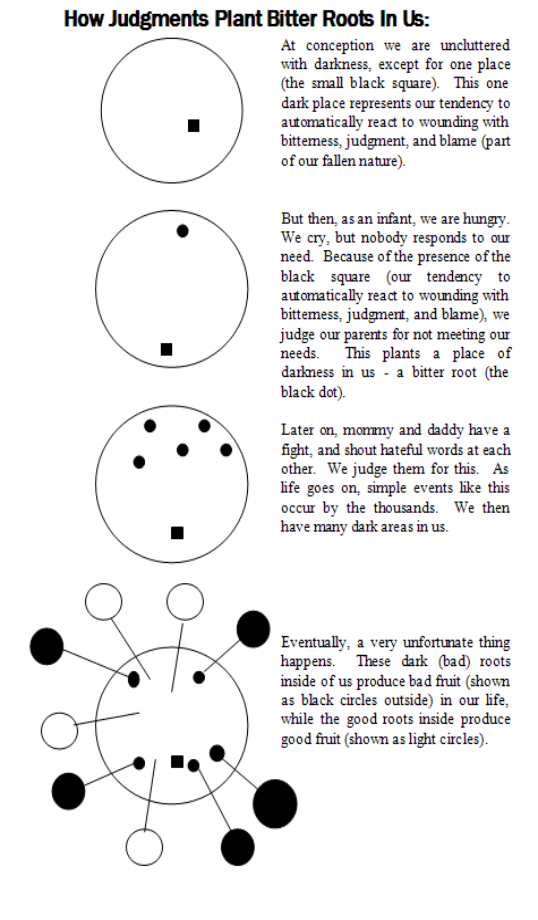
Daily we plant numerous roots of bitterness. Since life in this fallen world
entails lots of wounding, we do a lot of judging.
It is automatic, and we have done it before we consciously know
it.
Because we have planted many roots of bitterness, we are reaping much
bad fruit.
Tragically, as long as we walk this earth, we will never lose this
tendency to automatically react to wounding with bitterness,
judgment and blame.
This tendency is an integral part of our fallen human nature.
The Bad News and The Good News
We all judge, and we do it often. If you think you don’t do it, there is one
sure way to discover the truth. Ask yourself, do you do the things that you
hate to do? Is there bad fruit in your life? If there is bad fruit, there are
roots of bitterness in you.
Fortunately, you now have a way to clean up the mess. As often as you
judge, you can forgive and be forgiven. The bad root can be pulled out as
soon as it is planted.
How Can You Tell The Difference?
At first glance this may seem terribly confusing. How can you tell if the
judging you have just done is good or bad? Fortunately, the Lord has
provided a very simple way to tell the difference.
Suppose I live in a small town and I am thinking about going into business
with a certain man. I check around and find out that this person has a
reputation for being dishonest, and so I decide not to go into business with
him. I have judged (discerned) as I am supposed to do.
Alternatively, suppose I live in the small town and I am thinking about
going into business with a certain man. Without first checking around and
discovering his reputation, I go into business with him. After the business
starts I discover that he is not honest. By the time I can get myself out of
the business deal it has cost me $100,000. I am now in possession of the
same information (that he isn't honest) as in the first example, but you can
be sure that in this situation I have done the bad type of judging.
How can I tell that I have done the bad judging? Every time I think about
that "jerk" I feel like strangling him. Every time I think of him I become very
angry and upset. He wounded me, and I judged him for it.
On the other hand, in the first example, I am probably not upset with the
man, because I didn't judge him wrongly. After all, he didn't wound me. I
am at peace.
How can I tell whether I have judged someone in the way that I am not
supposed to? I feel it. I can absolutely feel the bitterness of the bitter root
that has been planted inside me.
When I realize that I have judged him in the way that I am not supposed to, I
can forgive him and be forgiven by Jesus (see Chapter 5, "Forgiving Ends
These Problems"). Then I no longer feel like calling him a "jerk."
We can feel the planting of a bitter root, because we have built into us a
sensitivity to wounding in our heart. A parallel to this would be when we
get a splinter in our finger. We have built into us a sensitivity to physical
wounding. When a splinter gets lodged in our finger, we know it is there
because we feel it. When we remove the splinter, our body will know that
and will tell us by a feeling of relief of the discomfort. Likewise, when we
remove the bitter root, our heart will know that and will tell us (if we are
listening) by a feeling of peace in place of the bitterness.
Denial - A Defense Mechanism
Most of the time we can tell whether we have judged another person by the
feeling. However, there are times when we will not feel bitterness towards
the one who wronged us. When a wound we have received is particularly
severe, we may have built a defense to protect us from feeling the pain.
For instance, a girl may have been abused by her father, and yet have no
sense of her rage towards him. The pain she felt at the time was too big to
live with, so she cut herself off from the feeling. We call this sort of defense
mechanism "denial." However, it will still be possible to discover there is a
Bitter Root Judgment inside. In this sort of situation, because the
wounding was large, there will be bad fruit in her life that will indicate the
presence of a bad root; and so she can track backwards from the bad fruit
to the bad root.
Perceived Wounding
I have made the statement that we always automatically respond to
perceived wounding with bitterness, judgment, and blame. It doesn't
matter whether the other person actually, factually, wounded us. What
counts is that we feel that they did.
For instance, suppose I was abandoned by my parents when I was a small
child. This is a real wounding, and has made me sensitive to
abandonment. Then as an adult, suppose a friend of mine declines to go
to a ballgame with me, telling me he is too tired. I feel abandoned and
judge him, because it seems to me he was making an excuse. Later I find
out the friend was coming down with the flu, and he really had wanted to
go to the game with me.
There was no actual wound inflicted by my friend, but I wrongly perceived
there was, so I judged. My prior wounds and judgments make me
more sensitive to how others behave around me.
The Lord Makes Us Less
Hypersensitive
As the Lord heals these wounded areas, I will react less often, because I
will perceive less wounding less often. However, this change should not
be confused with my built in human tendency to react with bitterness,
judgment and blame. I don't react less now because that tendency has
gone away or is being healed. I react less because I perceive wounding
less often. The next time I am actually wounded by someone, I will
discover that my tendency to judge has not gone away, because I will
again find myself judging.
The sequence that occurs is as follows: My friend declines my invitation. I
perceive that I have been wounded (abandoned). This automatically
triggers my judging, which plants a root of bitterness in my heart. I then
feel abandoned, making me aware, after the fact, that the root of bitterness
has been planted inside.
This is why "judging" is so damaging to us. To make matters worse, the
longer a bad root grows inside us, the bigger it gets, the more entrenched
it is, and the more difficult it is to eradicate. The bigger the root, the more
pervasive is the bad fruit.
It Is God’s Mercy That We Feel
Emotional Pain!
If we did not feel the emotional pain, we wouldn’t know there is something
wrong inside, and the sin would remain in us. When we die, we will go to
the Great White Throne Judgment, and there all our sins will be placed
before us. Scripture doesn’t tell us what the negative consequences will
be, but there is a strong implication that we would be better off without
those sins.
Since the sins that have been washed away by Jesus during our lifetime
will not be there, we won’t have to pay the price for them at the last
judgment.
Because the Lord takes the long view, including eternity, He wants to have
the opportunity to forgive our sins here, in this life, before we face the Last
Judgment. Of course, our unforgiven sins will not keep us out of heaven.
We will still be saved, but we will suffer loss.
We do not know when our life on earth will end. But as time goes by the
end of our life draws nearer. It therefore becomes more and more urgent
that we give our sins to Jesus. God therefore increases the pain, and our
burdens get harder to carry until we get desperate enough to seek the
cause. We need to forgive now so we won’t have to pay later.
God Changes Us Into His Image
In Chapter 2 I talked about the place of our will power, and the fact that in
Western culture our will power has been placed upon the throne of our
lives. This view is so subtle, pervasive, and automatic that it can sneak
into our thinking undetected. For example, some Bible teachers try to
explain that the way to walk out the Christian life is for God to strengthen
our will so that we can obey. These teachers believe that our will power is
the tool to bring victory.
But what God intends is for us to be changed into His image. It is a
miracle. When He removes a bitter root and comes to live in that place in
us, obeying Him is automatic and effortless. In fact, it is so effortless that
we may not even realize that we are behaving differently. The good root
produces good fruit, because it can do nothing else.
Summary
We all automatically react to perceived wounding with bitterness,
judgment, and blame. This flaw is a part of our fallen nature. We do this
many times daily, and this is sin. Every time we do this we plant a bitter
root which, in time, will bear bad fruit. The more that we are wounded, the
more bitter roots we have planted, and the more we will be reaping bad
things in our life. God's laws are operating against us.
It is therefore important to realize that what is going wrong in our
life is not because of what others did to us, but it is because of
our bitter reaction to what they did.
The good news is that there is a "cure" for the damage the sinning has
caused.
Since most of the bad roots that make such a shambles of our
lives come from the sin of judging, of taking Jesus' place as Lord
of our lives at that moment of judging, you are now in a place to
understand the cure: if we forgive the one who offended us,
then we are forgiven by Jesus. Then the bad root is washed
away, and the bad fruit stops. But we need to understand how to
forgive, which is the subject of Chapter 5.
Get The Rest Of The Story
My book, "I Will Give You Rest," gives you the whole story,
including the scriptures revealing how Jesus and you can do this
If what you have been reading makes sense to you, then to
actually take this journey out of anger and into peace, you need
to get the book.
He came to give us life here and now, not just in the life to come.
Copyright 2003 by Edward Kurath
Judging Causes Problems
(taken from the book "I Will Give You Rest" by Edward Kurath)
Because you have a problem with anger, this means that you judge a lot.
Well, welcome to the human race. We all "judge" a lot. The major
difference between you and those who do not seem to struggle with anger
is that they do not try as hard to hold it inside. Remember the picture I
gave you earlier about the pressure cooker. If a person lets the steam
come out on a regular basis, the pressure cooker does not explode.
We All Sin Frequently By Judging
If I were to observe that my neighbor never mows his lawn and that his
yard is always a mess, somebody may say to me, "Don't be so
judgmental." When I observe this about my neighbor, am I judging? Am I
sinning? It is certainly important for us to know the answer to these
questions so that we can avoid sinning and thus creating problems for
ourselves as a result. Of course there are other sins besides "judging,"
but this particular sin causes the most problems in our lives.
There Is Both "Good" And "Bad"
Judging
"Judging" is not always sin. The Bible talks about four types of judging,
three types that are not sin (good judging), and one that is sin (bad
judging). What is confusing is that the Bible uses the same Greek word to
refer to all four types, and so one must rely on the context to discern which
type is being referred to.
Good judging:
- 1. The judging that Jesus does. Since He is the just and righteous
Judge Who has been appointed to this position, He has a right to do
this.
2. The judicial authority that is to be exercised corporately by the
Church in regard to members of the Church. Judging in this context
is appropriate and ordained by God.
3. An activity that we are supposed to engage in as individual
Christians. An English word that would perhaps be more appropriate
for this function would be “discernment." We are to use wisdom and
to exercise discernment. It is not only permissible to see the negative
in a situation or a person, we are encouraged to do so.
4. The fourth type of judging is the type of judging that we are not
supposed to do as individual Christians. This type of judging by us is
sin. When we do this type of judging, we are seeing the negative in a
situation or a person, but we are also setting ourselves up as the
judge, jury, and hangman.
There are, of course, many ways we can sin. However, of all the sins that
we commit, this "bad" judging is the sin that causes the most problems in
our lives. When we find ourselves doing the things that we hate, the root
that is causing this bad fruit is almost always a judgement.
- . . . lest any root of bitterness springing up cause trouble, and by this
many become defiled (Hebrews 12:15).
Considering the size of the problem this sin causes, surely it must be a
very serious issue.
It is a bitter root judgment of some sort that is causing your
anger problems; and as a result of the bitterness springing up,
many are defiled.
Why We Do This:
The problem has its source in the Garden of Eden. When the serpent said,
- “For God knows that in the day you eat of it your eyes will be opened,
and you will be like God, knowing good and evil” (Genesis 3:5).
Adam and Eve took this bait because something inside of them wanted to
be like God. Satan knew all about this sin, because this was also his big
transgression.
Therefore, when we judge another we are taking the place of Jesus, and of
course this is a very serious transgression. Jesus is the only one who has
the right to judge.
Jesus Is The Only Judge
So when we judge, we are usurping God’s place. When we do this, we are
violating the first Great Commandment:
"You shall love the Lord your God with all your heart, with all your
soul, and with all your mind" (Matthew 22:37).
There is only one God, and it isn't us! We are doing the judging because
we do not trust God to take care of us and to hold others accountable
when they trespass against us (and therefore wound us). We feel we must
take the law into our own hands; because if we don’t do it, we believe that
nobody will.
All major problems in our human life have their roots in the Garden of
Eden, and in the two great commandments of Jesus (Matthew 22:36-40).
God has truly explained spiritual reality to us in such simple terms!
Our Weakness
Why do we all judge so quickly? It is a part of our fallen nature. When we
perceive that we have been wounded, we always automatically react
with bitterness, judgment, and blame. For instance, picture yourself
in your kitchen cutting up a carrot. The phone rings, and you lose your
concentration and cut your finger instead of the carrot.
What is your immediate response?
Do you blame the carrot? Do you blame the dull knife? Do you blame your
spouse for not sharpening the knife? Do you blame the person who called
you? Or do you blame yourself, saying something like this, "You dummy.
Why weren’t you paying more attention to what you were doing?"
Blaming myself was always my typical response.
Why couldn't the cut finger just be something that happened?
Why did somebody or something have to be at fault?
The answer is because it is our fallen nature to judge.
This is the problem.
Daily we plant numerous roots of bitterness. Since life in this fallen world
entails lots of wounding, we do a lot of judging.
It is automatic, and we have done it before we consciously know
it.
Because we have planted many roots of bitterness, we are reaping much
bad fruit.
Tragically, as long as we walk this earth, we will never lose this
tendency to automatically react to wounding with bitterness,
judgment and blame.
This tendency is an integral part of our fallen human nature.
The Bad News and The Good News
We all judge, and we do it often. If you think you don’t do it, there is one
sure way to discover the truth. Ask yourself, do you do the things that you
hate to do? Is there bad fruit in your life? If there is bad fruit, there are
roots of bitterness in you.
Fortunately, you now have a way to clean up the mess. As often as you
judge, you can forgive and be forgiven. The bad root can be pulled out as
soon as it is planted.
How Can You Tell The Difference?
At first glance this may seem terribly confusing. How can you tell if the
judging you have just done is good or bad? Fortunately, the Lord has
provided a very simple way to tell the difference.
Suppose I live in a small town and I am thinking about going into business
with a certain man. I check around and find out that this person has a
reputation for being dishonest, and so I decide not to go into business with
him. I have judged (discerned) as I am supposed to do.
Alternatively, suppose I live in the small town and I am thinking about
going into business with a certain man. Without first checking around and
discovering his reputation, I go into business with him. After the business
starts I discover that he is not honest. By the time I can get myself out of
the business deal it has cost me $100,000. I am now in possession of the
same information (that he isn't honest) as in the first example, but you can
be sure that in this situation I have done the bad type of judging.
How can I tell that I have done the bad judging? Every time I think about
that "jerk" I feel like strangling him. Every time I think of him I become very
angry and upset. He wounded me, and I judged him for it.
On the other hand, in the first example, I am probably not upset with the
man, because I didn't judge him wrongly. After all, he didn't wound me. I
am at peace.
How can I tell whether I have judged someone in the way that I am not
supposed to? I feel it. I can absolutely feel the bitterness of the bitter root
that has been planted inside me.
When I realize that I have judged him in the way that I am not supposed to, I
can forgive him and be forgiven by Jesus (see Chapter 5, "Forgiving Ends
These Problems"). Then I no longer feel like calling him a "jerk."
We can feel the planting of a bitter root, because we have built into us a
sensitivity to wounding in our heart. A parallel to this would be when we
get a splinter in our finger. We have built into us a sensitivity to physical
wounding. When a splinter gets lodged in our finger, we know it is there
because we feel it. When we remove the splinter, our body will know that
and will tell us by a feeling of relief of the discomfort. Likewise, when we
remove the bitter root, our heart will know that and will tell us (if we are
listening) by a feeling of peace in place of the bitterness.
Denial - A Defense Mechanism
Most of the time we can tell whether we have judged another person by the
feeling. However, there are times when we will not feel bitterness towards
the one who wronged us. When a wound we have received is particularly
severe, we may have built a defense to protect us from feeling the pain.
For instance, a girl may have been abused by her father, and yet have no
sense of her rage towards him. The pain she felt at the time was too big to
live with, so she cut herself off from the feeling. We call this sort of defense
mechanism "denial." However, it will still be possible to discover there is a
Bitter Root Judgment inside. In this sort of situation, because the
wounding was large, there will be bad fruit in her life that will indicate the
presence of a bad root; and so she can track backwards from the bad fruit
to the bad root.
Perceived Wounding
I have made the statement that we always automatically respond to
perceived wounding with bitterness, judgment, and blame. It doesn't
matter whether the other person actually, factually, wounded us. What
counts is that we feel that they did.
For instance, suppose I was abandoned by my parents when I was a small
child. This is a real wounding, and has made me sensitive to
abandonment. Then as an adult, suppose a friend of mine declines to go
to a ballgame with me, telling me he is too tired. I feel abandoned and
judge him, because it seems to me he was making an excuse. Later I find
out the friend was coming down with the flu, and he really had wanted to
go to the game with me.
There was no actual wound inflicted by my friend, but I wrongly perceived
there was, so I judged. My prior wounds and judgments make me
more sensitive to how others behave around me.
The Lord Makes Us Less
Hypersensitive
As the Lord heals these wounded areas, I will react less often, because I
will perceive less wounding less often. However, this change should not
be confused with my built in human tendency to react with bitterness,
judgment and blame. I don't react less now because that tendency has
gone away or is being healed. I react less because I perceive wounding
less often. The next time I am actually wounded by someone, I will
discover that my tendency to judge has not gone away, because I will
again find myself judging.
The sequence that occurs is as follows: My friend declines my invitation. I
perceive that I have been wounded (abandoned). This automatically
triggers my judging, which plants a root of bitterness in my heart. I then
feel abandoned, making me aware, after the fact, that the root of bitterness
has been planted inside.
This is why "judging" is so damaging to us. To make matters worse, the
longer a bad root grows inside us, the bigger it gets, the more entrenched
it is, and the more difficult it is to eradicate. The bigger the root, the more
pervasive is the bad fruit.
It Is God’s Mercy That We Feel
Emotional Pain!
If we did not feel the emotional pain, we wouldn’t know there is something
wrong inside, and the sin would remain in us. When we die, we will go to
the Great White Throne Judgment, and there all our sins will be placed
before us. Scripture doesn’t tell us what the negative consequences will
be, but there is a strong implication that we would be better off without
those sins.
Since the sins that have been washed away by Jesus during our lifetime
will not be there, we won’t have to pay the price for them at the last
judgment.
Because the Lord takes the long view, including eternity, He wants to have
the opportunity to forgive our sins here, in this life, before we face the Last
Judgment. Of course, our unforgiven sins will not keep us out of heaven.
We will still be saved, but we will suffer loss.
We do not know when our life on earth will end. But as time goes by the
end of our life draws nearer. It therefore becomes more and more urgent
that we give our sins to Jesus. God therefore increases the pain, and our
burdens get harder to carry until we get desperate enough to seek the
cause. We need to forgive now so we won’t have to pay later.
God Changes Us Into His Image
In Chapter 2 I talked about the place of our will power, and the fact that in
Western culture our will power has been placed upon the throne of our
lives. This view is so subtle, pervasive, and automatic that it can sneak
into our thinking undetected. For example, some Bible teachers try to
explain that the way to walk out the Christian life is for God to strengthen
our will so that we can obey. These teachers believe that our will power is
the tool to bring victory.
But what God intends is for us to be changed into His image. It is a
miracle. When He removes a bitter root and comes to live in that place in
us, obeying Him is automatic and effortless. In fact, it is so effortless that
we may not even realize that we are behaving differently. The good root
produces good fruit, because it can do nothing else.
Summary
We all automatically react to perceived wounding with bitterness,
judgment, and blame. This flaw is a part of our fallen nature. We do this
many times daily, and this is sin. Every time we do this we plant a bitter
root which, in time, will bear bad fruit. The more that we are wounded, the
more bitter roots we have planted, and the more we will be reaping bad
things in our life. God's laws are operating against us.
It is therefore important to realize that what is going wrong in our
life is not because of what others did to us, but it is because of
our bitter reaction to what they did.
The good news is that there is a "cure" for the damage the sinning has
caused.
Since most of the bad roots that make such a shambles of our
lives come from the sin of judging, of taking Jesus' place as Lord
of our lives at that moment of judging, you are now in a place to
understand the cure: if we forgive the one who offended us,
then we are forgiven by Jesus. Then the bad root is washed
away, and the bad fruit stops. But we need to understand how to
forgive, which is the subject of Chapter 5.
Get The Rest Of The Story
My book, "I Will Give You Rest," gives you the whole story,
including the scriptures revealing how Jesus and you can do this
If what you have been reading makes sense to you, then to
actually take this journey out of anger and into peace, you need
to get the book.
He came to give us life here and now, not just in the life to come.
Copyright 2003 by Edward Kurath
| <script src="http://www.google-analytics.com/urchin.js" type="text/javascript"> </script> <script type="text/javascript"> _uacct = "UA-3939231-1"; urchinTracker(); </script> |
Divinely Designed
Being changed into the image of Jesus
Being changed into the image of Jesus


|
to Chapter 5 to learn the cure. |
 | |  | |  | |  | |  |
 | |  | |  | |  | |  |
 |
| |
 |
| |
 |
| |
 |
| |
 |
| |
 |
| |
 |
| |
 |
| |
 |
| |
 |
| |
 |
google-site-verification: google33dc0642320fcbef.html
