Divinely Designed
Being changed into the image of Jesus
Being changed into the image of Jesus
Chapter 3
Remove All The Bad Roots
It Is Possible
(taken from the book "I Will Give You Rest" by Edward Kurath)
Just because you have a "bad root" inside that expresses itself in
angry outbursts does not mean that you are all bad, or that there is no
hope, or that you aren't saved.
A subtle but profound misunderstanding of what we are like inside has
made it difficult for many Christians to see how there can be sin inside
us, and yet still be saved.
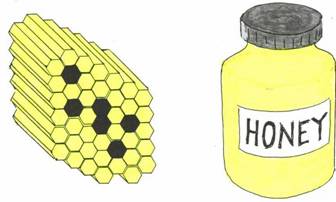
There is a prevalent view that implies that inside we are like a jar, a
container with a single compartment. According to this view,
therefore, when we give our life to Jesus, He forgives all our sins and
the jar is now clean. Now that we are pure on the inside, we should be
able to act pure on the outside.
This Is Not The Way We Are Inside
The reason this view is erroneous is that, unfortunately, this is never
the way it works. I know of no one, including myself, for whom life has
been this way. And it was not that way for Paul when he wrote the
book of Romans (specifically Chapter 7) for us.
The Way It Is
The truth is that inside we are more like a honeycomb than a honey
jar. We have many compartments inside, not just one. Some of the
compartments contain Jesus, and those are like the "good roots"
referred to in Scripture, and which I referred to in the prior chapter.
These good roots produce good fruit.
Presence Of Bad Roots
However, some of the compartments still contain bad roots. These
bad roots produce bad fruit, as I have previously mentioned, and they
are still present and continue to produce bad fruit even after we
become a Christian. These bad roots are shown as dark spots in the
following honeycomb diagram.
Honeycomb Honey Jar
Cleaning The "Honeycomb"
We need to bring Jesus into each compartment of the "Honeycomb"
that has darkness in it. This transformation is a process, not a one-
time event.
This is the sanctification process which is addressed in so many
places in the Bible. Bringing Jesus into each compartment is the
process of being changed into His image.
Once Jesus has taken up residence in that particular place in our
"Honeycomb," He produces the good fruit automatically, because
Jesus can do nothing but produce good fruit. It is His nature. As He
takes over that part of our heart, His nature actually becomes
ours in that area. This good root that now resides in that part of our
"Honeycomb" then produces good fruit.
For instance, if we have struggled with lying, we have found that trying
hard not to lie hasn't worked (trying implies use of our willpower). We
find ourselves still lying. We need to find the bad root. Perhaps we
realize that our father lied to us, and we judged him for it (we sinned by
judging him). This bad root is causing the bad fruit. When we deal
with the bad root and replace it with the life of Jesus, we find we just
don’t lie anymore. There is now good fruit, which is evidence of Jesus
in that place in us. It is now so natural not to lie that we may not even
be aware that we are different, because it is a new “us."
This Profound Change Is Possible
Does this sound too good to be true? Believe me, it is true. Better yet,
believe Jesus when He said,
When Jesus cleanses one compartment of the Honeycomb, it does not
mean that all the compartments are clean. Other bad roots will
undoubtedly remain, and they will be causing other bad fruit. We need
to continue being transformed as God shows us areas in our heart that
need healing. This is what Paul meant when he said,
We will look more fully at the necessity to keep working on this
process in Chapter 17, “It Is A Journey."
We Can't Make It happen!
When we read a scripture like this, we tend to strive to keep His
commandments, because we want to please God. We want Him to
know that we love Him, and it seems as though this scripture is telling
us that the way we can prove our love for him is to keep His
commandments. How can one reconcile this with what we have been
discovering about our inability to keep His commandments in our own
strength (that is, with our willpower)?
Fortunately, Jesus clearly explains what He meant in the context
surrounding the above scripture. The explanation is in John 15:5,
which is sandwiched between two scriptures that talk about keeping
His commandments.
Keeping this in mind, then John 15:10 is saying something like, "If you
keep My commandments this is evidence that you have been changed
into My image, because on your own you could not do it. When you
have My nature, you love the Father in exactly the same way that I do."
Jesus loves the Father because that is His nature.
Behavior Is The Evidence, Not The
Goal
The reason that we can be thrown into striving to keep God's
commandments is that we are confused about how we go about
pleasing God. We focus on our behavior (keeping the
commandments) rather than the cause of the behavior (our heart
condition). We try to keep the commandments in order to prove that
we love God.
That is backwards.
We can only please God by first being changed into the image of
Jesus, and then we will keep the commandments because that is now
our new nature. The heart has to change first, and then the behavior
will change.
Changing our behavior does not change our heart. 1 John 4:19 says,
Changed From The Inside Out
This is the direction of the flow, from God to us, not the other way
around. If you are not clear on this, you can misread many scriptures.
I would suggest that you read John 14:15 through 15:17 in your Bible
to get the full flow of what Jesus is saying.
Let me illustrate this with a parallel. Imagine that I break my leg. It
hurts, so I take a painkiller, and it hurts less (I manipulate the
symptom). But the leg is still broken (the cause). If I neglect the
painkiller, it hurts a lot. If the doctor said that a healthy leg shouldn't
hurt, I would agree. If mine weren't broken, it wouldn't hurt. But
saying my broken leg shouldn't hurt doesn't keep it from hurting. The
only way for my leg pain to go away (the symptom, or bad fruit) is for
my broken leg (the cause, or bad root) to heal (be changed to a good
root).
Similarly, when I sin, there is a wound in my heart. It causes emotional
pain and I have bad fruit, so I try to act differently (I manipulate the
symptom). But it doesn't work very well, because there is a bad root
inside me (the cause). When Jesus says that I should keep His
commandments, I would agree. If I didn't have the bad root in my
heart, the bad things wouldn't happen. But saying I should keep His
commandments does not make it possible as long as Jesus isn’t
abiding in that particular area of my heart (my heart is wounded). The
only way I can keep the commandments (the symptom) is for my
wounded heart (the cause, or bad root) to be healed and for Jesus to
take up residence there (the bad root to be changed to a good root).
The symptom is not the cause. We have had it backwards, and have
focused on the symptom (the fruit outside) and not the cause (the root
inside).
When Jesus says that we should keep His commandments He is
simply saying that is how we can tell whether there is a bad
root inside us. Be careful not to be confused about this. The
emphasis is never on the fruit, but is always upon the root. Focusing
on the bad fruit can set us to striving to keep the commandments with
our willpower - and thus doom us to failure. It is a subtle but deadly
trap, and we so easily stumble on this stumbling stone.
Confusing Scriptures
There are many scriptures that can be misunderstood if we confuse
the fruit with the root. The book of James has some significant
examples of these kinds of scriptures, such as:
These scriptures are simply saying that if there are no "works" (no
good fruit) this is evidence that there is no "faith" (no good root). They
are not mandating "trying" with our willpower. Good fruit is all about
outward evidence (our behavior), whereas good roots are all about the
cause (conditions hidden inside us).
How To Obey His Commands
When we find it difficult to obey a commandment of the Lord, we have
three choices:
1. We can ignore the command.
2. We can try to obey the command in our own strength (our
willpower), which is the Downward Path below.
3. We can have the Lord deal with the bad root through the blood
of Jesus, which is the Healing Path below.
The healing path is to bring Jesus into each bad root in our
"Honeycomb." Unfortunately we also frequently plant new bad roots
inside.
There are many ways that we all sin and thus plant more bad roots in
our "Honeycomb." However, the sin that produces most of the
damage and destruction in our lives is the sin of judging. Jesus
singled out this sin when He said,
When we judge another, we will surely reap bad consequences.
When we plant a bad root in our "Honeycomb" by judging, we can call
the bad root a "bitter root" and the action of judging a "Bitter Root
Judgment." I will frequently use these terms in the rest of the book.
In the next chapter it will become more clear why this particular sin of
judging is so serious and so destructive.
Now that you understand the truth about bad fruit and bad roots, it
should be clear that this process is not something for only a few
Christians who are really sick emotionally. We all sin and fall short of
the glory of God (Romans 3:23), and Jesus died to set all of us free
from this bondage. This process of being changed into the image of
Jesus, which is also called "Inner Healing" by some people, and
referred to as "sanctification" in the Bible.
Those who claim not to need this process are in a pitiful state, because
they are blind. As long as they remain blind, there is no hope for them
in this life.
Chapter Summary
We all have a tendency to sin often. When we do, we plant dark places
in our "Honeycomb," and these prevent us from following God's laws
in those particular areas of our life. These bad roots produce bad
fruit. When we repent and bring Jesus into those dark areas of our
"Honeycomb," one area at a time, we are changed into His image, step
by step. As He takes up residence in those particular areas, the
cursing side of the law stops. The good root of Jesus produces good
fruit.
God's commandments are a way of measuring whether we have a bad
root inside. If we misunderstand and thus try to keep them with our
willpower, we will fail.
Even though we have the tendency to sin often, we have the living
presence of Jesus, and He provides His blood to wash us clean every
time. There is no shortage of the blood of Jesus. Through this
provision, He has provided the way for us to be set free from the sins
that beset us, by changing us into His image.
Jesus' Promise Is True!
Now perhaps you can better understand why Matthew 11:28-30 and
the title of this book so clearly describe your struggle.
How This Relates To Your Anger
When there is "bad fruit" (outbursts of anger), then there is a "bad
root."
What sort of experience would cause such a "bad root" to be planted?
There are many possibilities, but they generally fall into two categories.
The common thread for both of these childhood experiences is
judging, or "bitter root judgments." In the first case the judgment was
against another person, and in the second case the judgment was
against themselves. The next chapter (Chapter 4) will explain why
"judging" plants "bad roots" that produce irresistible "bad fruit" -such
as angry outbursts that you can not control.
My book, "I Will Give You Rest" gives you the whole story,
including the scriptures revealing how Jesus and you can do
this.
Get The Whole Story
If what you have been reading makes sense to you, then to
actually take this journey out of anger and into peace, you
need the whole story by buying the book.
He came to give us life here and now, not just in the life to
come.
Remove All The Bad Roots
It Is Possible
(taken from the book "I Will Give You Rest" by Edward Kurath)
Just because you have a "bad root" inside that expresses itself in
angry outbursts does not mean that you are all bad, or that there is no
hope, or that you aren't saved.
A subtle but profound misunderstanding of what we are like inside has
made it difficult for many Christians to see how there can be sin inside
us, and yet still be saved.
There is a prevalent view that implies that inside we are like a jar, a
container with a single compartment. According to this view,
therefore, when we give our life to Jesus, He forgives all our sins and
the jar is now clean. Now that we are pure on the inside, we should be
able to act pure on the outside.
This Is Not The Way We Are Inside
The reason this view is erroneous is that, unfortunately, this is never
the way it works. I know of no one, including myself, for whom life has
been this way. And it was not that way for Paul when he wrote the
book of Romans (specifically Chapter 7) for us.
The Way It Is
The truth is that inside we are more like a honeycomb than a honey
jar. We have many compartments inside, not just one. Some of the
compartments contain Jesus, and those are like the "good roots"
referred to in Scripture, and which I referred to in the prior chapter.
These good roots produce good fruit.
- But the fruit of the Spirit is love, joy, peace, longsuffering,
kindness, goodness (Galatians 5:22-23).
- "Even so, every good tree bears good fruit, but a bad tree bears
bad fruit. A good tree cannot bear bad fruit, nor can a bad tree
bear good fruit. A good tree cannot bear bad fruit, nor can a bad
tree bear good fruit. . . Therefore by their fruits you will know
them." (Matthew 7:17-18, 20).
Presence Of Bad Roots
However, some of the compartments still contain bad roots. These
bad roots produce bad fruit, as I have previously mentioned, and they
are still present and continue to produce bad fruit even after we
become a Christian. These bad roots are shown as dark spots in the
following honeycomb diagram.
Honeycomb Honey Jar
Cleaning The "Honeycomb"
We need to bring Jesus into each compartment of the "Honeycomb"
that has darkness in it. This transformation is a process, not a one-
time event.
This is the sanctification process which is addressed in so many
places in the Bible. Bringing Jesus into each compartment is the
process of being changed into His image.
Once Jesus has taken up residence in that particular place in our
"Honeycomb," He produces the good fruit automatically, because
Jesus can do nothing but produce good fruit. It is His nature. As He
takes over that part of our heart, His nature actually becomes
ours in that area. This good root that now resides in that part of our
"Honeycomb" then produces good fruit.
For instance, if we have struggled with lying, we have found that trying
hard not to lie hasn't worked (trying implies use of our willpower). We
find ourselves still lying. We need to find the bad root. Perhaps we
realize that our father lied to us, and we judged him for it (we sinned by
judging him). This bad root is causing the bad fruit. When we deal
with the bad root and replace it with the life of Jesus, we find we just
don’t lie anymore. There is now good fruit, which is evidence of Jesus
in that place in us. It is now so natural not to lie that we may not even
be aware that we are different, because it is a new “us."
This Profound Change Is Possible
Does this sound too good to be true? Believe me, it is true. Better yet,
believe Jesus when He said,
- "Therefore you shall be perfect, just as your Father in heaven is
perfect" (Matthew 5:48, I added the red).
When Jesus cleanses one compartment of the Honeycomb, it does not
mean that all the compartments are clean. Other bad roots will
undoubtedly remain, and they will be causing other bad fruit. We need
to continue being transformed as God shows us areas in our heart that
need healing. This is what Paul meant when he said,
- work out your own salvation with fear and trembling; for it is
God who works in you both to will and to do for His good
pleasure (Philippians 2:12-13).
We will look more fully at the necessity to keep working on this
process in Chapter 17, “It Is A Journey."
We Can't Make It happen!
- "If you love Me, keep My commandments" (John 14:15).
When we read a scripture like this, we tend to strive to keep His
commandments, because we want to please God. We want Him to
know that we love Him, and it seems as though this scripture is telling
us that the way we can prove our love for him is to keep His
commandments. How can one reconcile this with what we have been
discovering about our inability to keep His commandments in our own
strength (that is, with our willpower)?
Fortunately, Jesus clearly explains what He meant in the context
surrounding the above scripture. The explanation is in John 15:5,
which is sandwiched between two scriptures that talk about keeping
His commandments.
- "He who has My commandments and keeps them, it is he who
loves Me. And he who loves Me will be loved by My Father, and
I will love him and manifest Myself to him" ( John 14:21).
- " I am the vine, you are the branches. He who abides in Me, and
I in him, bears much fruit; for without Me you can do nothing"
(John 15:5, I added the underlining).
"If you keep My commandments, you will abide in My love, just
as I have kept My Father's commandments and abide in His
love" (John 15:10).
Keeping this in mind, then John 15:10 is saying something like, "If you
keep My commandments this is evidence that you have been changed
into My image, because on your own you could not do it. When you
have My nature, you love the Father in exactly the same way that I do."
Jesus loves the Father because that is His nature.
Behavior Is The Evidence, Not The
Goal
The reason that we can be thrown into striving to keep God's
commandments is that we are confused about how we go about
pleasing God. We focus on our behavior (keeping the
commandments) rather than the cause of the behavior (our heart
condition). We try to keep the commandments in order to prove that
we love God.
That is backwards.
We can only please God by first being changed into the image of
Jesus, and then we will keep the commandments because that is now
our new nature. The heart has to change first, and then the behavior
will change.
Changing our behavior does not change our heart. 1 John 4:19 says,
- We love him because He first loved us.
Changed From The Inside Out
This is the direction of the flow, from God to us, not the other way
around. If you are not clear on this, you can misread many scriptures.
I would suggest that you read John 14:15 through 15:17 in your Bible
to get the full flow of what Jesus is saying.
Let me illustrate this with a parallel. Imagine that I break my leg. It
hurts, so I take a painkiller, and it hurts less (I manipulate the
symptom). But the leg is still broken (the cause). If I neglect the
painkiller, it hurts a lot. If the doctor said that a healthy leg shouldn't
hurt, I would agree. If mine weren't broken, it wouldn't hurt. But
saying my broken leg shouldn't hurt doesn't keep it from hurting. The
only way for my leg pain to go away (the symptom, or bad fruit) is for
my broken leg (the cause, or bad root) to heal (be changed to a good
root).
Similarly, when I sin, there is a wound in my heart. It causes emotional
pain and I have bad fruit, so I try to act differently (I manipulate the
symptom). But it doesn't work very well, because there is a bad root
inside me (the cause). When Jesus says that I should keep His
commandments, I would agree. If I didn't have the bad root in my
heart, the bad things wouldn't happen. But saying I should keep His
commandments does not make it possible as long as Jesus isn’t
abiding in that particular area of my heart (my heart is wounded). The
only way I can keep the commandments (the symptom) is for my
wounded heart (the cause, or bad root) to be healed and for Jesus to
take up residence there (the bad root to be changed to a good root).
The symptom is not the cause. We have had it backwards, and have
focused on the symptom (the fruit outside) and not the cause (the root
inside).
When Jesus says that we should keep His commandments He is
simply saying that is how we can tell whether there is a bad
root inside us. Be careful not to be confused about this. The
emphasis is never on the fruit, but is always upon the root. Focusing
on the bad fruit can set us to striving to keep the commandments with
our willpower - and thus doom us to failure. It is a subtle but deadly
trap, and we so easily stumble on this stumbling stone.
Confusing Scriptures
There are many scriptures that can be misunderstood if we confuse
the fruit with the root. The book of James has some significant
examples of these kinds of scriptures, such as:
- • Thus also faith by itself, if it does not have works, is dead
(James 2:17).
• You see then that a man is justified by works, and not by
faith only (James 2:24).
These scriptures are simply saying that if there are no "works" (no
good fruit) this is evidence that there is no "faith" (no good root). They
are not mandating "trying" with our willpower. Good fruit is all about
outward evidence (our behavior), whereas good roots are all about the
cause (conditions hidden inside us).
How To Obey His Commands
When we find it difficult to obey a commandment of the Lord, we have
three choices:
1. We can ignore the command.
2. We can try to obey the command in our own strength (our
willpower), which is the Downward Path below.
3. We can have the Lord deal with the bad root through the blood
of Jesus, which is the Healing Path below.
- A. The Downward Path
- Perceived wound
- We sin
- Bad Root planted
- Bad Fruit results from the bad root.
- OR
B. The Healing Path
- Perceived wound
- We sin
- We repent
- We receive forgiveness (bad root uprooted)
- Good root planted (infilling of Jesus)
- Good Fruit results effortlessly from the good root.
The healing path is to bring Jesus into each bad root in our
"Honeycomb." Unfortunately we also frequently plant new bad roots
inside.
There are many ways that we all sin and thus plant more bad roots in
our "Honeycomb." However, the sin that produces most of the
damage and destruction in our lives is the sin of judging. Jesus
singled out this sin when He said,
- "Judge not, that you be not judged. For with what judgment you
judge, you will be judged; and with the same measure you use, it
will be measured back to you" (Matthew 7:1-2).
When we judge another, we will surely reap bad consequences.
When we plant a bad root in our "Honeycomb" by judging, we can call
the bad root a "bitter root" and the action of judging a "Bitter Root
Judgment." I will frequently use these terms in the rest of the book.
In the next chapter it will become more clear why this particular sin of
judging is so serious and so destructive.
Now that you understand the truth about bad fruit and bad roots, it
should be clear that this process is not something for only a few
Christians who are really sick emotionally. We all sin and fall short of
the glory of God (Romans 3:23), and Jesus died to set all of us free
from this bondage. This process of being changed into the image of
Jesus, which is also called "Inner Healing" by some people, and
referred to as "sanctification" in the Bible.
- It is the normal walk for all Christians.
Those who claim not to need this process are in a pitiful state, because
they are blind. As long as they remain blind, there is no hope for them
in this life.
Chapter Summary
We all have a tendency to sin often. When we do, we plant dark places
in our "Honeycomb," and these prevent us from following God's laws
in those particular areas of our life. These bad roots produce bad
fruit. When we repent and bring Jesus into those dark areas of our
"Honeycomb," one area at a time, we are changed into His image, step
by step. As He takes up residence in those particular areas, the
cursing side of the law stops. The good root of Jesus produces good
fruit.
God's commandments are a way of measuring whether we have a bad
root inside. If we misunderstand and thus try to keep them with our
willpower, we will fail.
Even though we have the tendency to sin often, we have the living
presence of Jesus, and He provides His blood to wash us clean every
time. There is no shortage of the blood of Jesus. Through this
provision, He has provided the way for us to be set free from the sins
that beset us, by changing us into His image.
Jesus' Promise Is True!
Now perhaps you can better understand why Matthew 11:28-30 and
the title of this book so clearly describe your struggle.
- Come to Me, all you who labor and are heavy laden, and I will give
you rest. Take My yoke upon you and learn from Me, for I am
gentle and lowly in heart, and you will find rest for your souls. For
My yoke is easy and My burden is light. (Matthew 11:28-30)
How This Relates To Your Anger
When there is "bad fruit" (outbursts of anger), then there is a "bad
root."
What sort of experience would cause such a "bad root" to be planted?
There are many possibilities, but they generally fall into two categories.
- 1. As a child, the person experienced a lot of anger from at
least one important person in their life, most commonly a parent.
They were frightened and hurt by this, and grew to hate it. They
judged that person, and they decided that they never want to be
like that. This can be a very deep root, because these sort of
events probably happened many times.
2. As a child, anger was never expressed in the family. This
gave them the message that anger is a bad thing, and should not
be expressed. When the child did express it, they were given a
clear message that was not acceptable. The child then judged
their own anger, and this became the bitter root.
- This was my personal experience. Then as an adult, whenever I
would get angry, I would feel ashamed for "losing it." I tied down
the valve on the pressure cooker, until it would eventually
explode.
The common thread for both of these childhood experiences is
judging, or "bitter root judgments." In the first case the judgment was
against another person, and in the second case the judgment was
against themselves. The next chapter (Chapter 4) will explain why
"judging" plants "bad roots" that produce irresistible "bad fruit" -such
as angry outbursts that you can not control.
My book, "I Will Give You Rest" gives you the whole story,
including the scriptures revealing how Jesus and you can do
this.
Get The Whole Story
If what you have been reading makes sense to you, then to
actually take this journey out of anger and into peace, you
need the whole story by buying the book.
He came to give us life here and now, not just in the life to
come.

Chapter 4. |
 | |  | |  | |  | |  |
 | |  | |  | |  | |  |
 |
| |
 |
| |
 |
| |
 |
| |
 |
| |
 |
| |
 |
| |
 |
| |
 |
| |
 |
| |
 |
